Linux was never worth it before AI

I started on Windows 3.11. Every few years since, I’ve looked at Linux, and every time I stayed where I was.
Linux was fine. Switching was the problem. Thirty years of knowing where everything is on Windows, every setting, every shortcut, every fix I can do half asleep, and all of it back to zero. That cost was never worth it to me.
Two months ago I switched to Omarchy, DHH’s Linux setup on top of Arch, and I’m not going back. What changed is that I now have an agent to do the learning for me.
Omarchy calls itself “the malleable OS for the age of agents”. After two months I know what that means in practice.
Ask instead of learning
On first boot Omarchy asks you to pick a default agent. SUPER + ` drops a console from the top of the screen with that agent in it.
That shortcut is most of my Linux knowledge.
I want to change something, I ask. Inspect something, install something, remove something: I ask. I learned the basics, how files, packages and services fit together. The rest is the agent’s job.
That works because of how Linux is built. Configuration is text, everything can be done with a CLI command, and most of the software is open source. An agent can read all of it and change all of it.
Windows and macOS keep a lot of that behind settings screens, a registry and components only the vendor can read. Nobody designed Linux for agents, but text and commands happen to be what an agent works with best.
The work side was easier than I feared. Dynamics 365, the Power Platform, Azure, Outlook and Teams all run in a browser. The one Windows tool I still need is XrmToolBox, and Omarchy has a built-in Windows VM for that.
When it’s a bug, the agent keeps going
That VM is where I found out how far the agent goes.
On the first run it refused to start. It failed a safety check on its shared folder, and I had no idea why, so I asked the agent. It worked out that chmod 0700 doesn’t clear the setgid bit on a directory. My folder was mode 2700 and the check wanted exactly 700. It ran chmod g-s ~/Windows and the VM started. All of this is gibberish to me, but the agent found the issue and fixed it.
Then it kept going. It checked whether someone had already reported the problem, found the issue, and added my reproduction to it. Two weeks later the fix was merged.
It works like that every time now. Most of the time the answer is a setting. When it’s a bug, the agent does what a maintainer would do with my report before the maintainer ever sees it: read the source, reproduce it, try a fix I can test, look for an existing issue. Then it asks if I want to report it, and writes the report.
My effort is close to zero.
The other side of the issue often has an agent too. Omarchy’s bot checks reports against the source, and signs off with lines like “Checked by Claude Opus 5.5 and Codex Medium, by reading the source.” So by the time a maintainer reads my report, two agents have already checked it.
DHH put it in four words on X: “We can fix everything.” The site he linked spells out what that covers: every missing app, every incompatibility, every paper cut.
The same report, sent to Microsoft
I’ve filed bugs with Microsoft for most of my career. They sit without a comment, or come back as “by design” or “won’t fix”. I can’t remember one of mine ever getting fixed, and at some point I stopped bothering.
In August I tried again. pac plugin push reports success while a new assembly in a plug-in package is never registered. I wrote it up and filed issue #1465 with a full reproduction, the same kind of report the agent writes for Omarchy.
Almost three months later it has no comments.
That’s one issue, and Microsoft is huge. What changed for me is that AI made a good bug report almost free to write, and that only pays off where someone reads it.
On Omarchy someone does. So I report bugs again, and I’d forgotten I liked it.
Extend what’s missing
Malleable also means adding what isn’t there.
Omarchy ships skills that help the agent build apps, plugins and themes. Its plugin page puts it plainly: “Don’t find what you need? Just put your agent on the job, then share when done.”
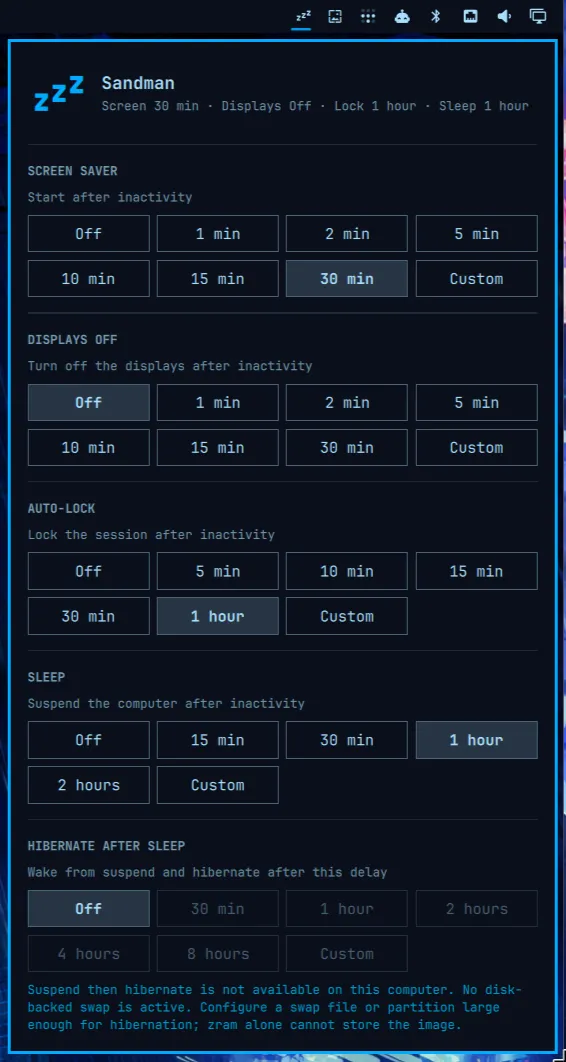
My mini PC stays on when I walk away from it, and the built-in idle settings were too coarse for that. Someone with the same gap had already built Sandman and shared it: a panel in the bar with separate settings for the screensaver, displays off, auto-lock, sleep and hibernate.
It isn’t all seamless. XrmToolBox in a VM is a workaround.
But the thing that kept me on Windows for thirty years is gone.
Linux didn’t get easier. I just don’t have to learn it alone anymore thanks to Omarchy.